5 Common Mistakes When Factoring Trinomials
Factoring trinomials is a core algebra skill, but it is also where many students get stuck. Most errors aren’t caused by “not knowing the math,” but by missing small steps that make the problem much harder than it needs to be.
Here is the first and most frequent mistake students make.
1. Skipping the Greatest Common Factor (GCF)
Students often try to factor the trinomial immediately without first checking for a common factor.
This makes the problem harder than it needs to be.
Example
Factor:
❌ Common Wrong Attempt
A student tries to factor the trinomial directly:
Because the numbers are larger than necessary, it becomes harder to find the correct factors.
✅ Correct Solution
First check for a Greatest Common Factor (GCF).
Each term contains a factor of 3, so factor it out:
Now factor the trinomial inside the parentheses:
Final Answer:
💡 Tip
Always check for a Greatest Common Factor (GCF) before factoring a trinomial.
Factoring out the GCF simplifies the expression and makes the remaining trinomial easier to factor.
2. Mixing Up Positive and Negative Signs
This mistake happens when a student finds the right numbers but assigns the plus or minus signs to the wrong binomial.
Example
Factor:
❌ Common Wrong Attempt
A student finds the factors and but assigns the negative sign to the larger number:
Check: . The middle term should be .
✅ Correct Solution
The factors of must add to . Since the sum is positive, the larger factor () must be positive:
💡 Tip
The “Add-Back” Test. Before moving on, mentally add your two numbers. If they don’t exactly match the middle coefficient (including the sign), your answer is wrong.
3. Matching Multiplication but Failing Addition
Many students find a pair of factors that multiply to the constant and assume they are finished without checking the sum.
Example
Factor:
❌ Common Wrong Attempt
A student sees and immediately thinks of :
Check: While , the sum . We need a sum of .
✅ Correct Solution
List all factor pairs of until the sum matches :
(Sum: )
(Sum: )
Final Answer:
💡 Tip
The Sum-Product Table. If you are stuck, draw a small table. Label one side “Product” and the other “Sum.” Don’t stop until both columns match your trinomial.
4. Ignoring the Leading Coefficient ()
Students often try to use the “simple” shortcut even when the term has a coefficient other than .
Example
Factor:
❌ Common Wrong Attempt
A student ignores the and factors it like a simple trinomial:
Check: . This does not match the original .
✅ Correct Solution
Use the AC Method. Multiply (). Find factors of that add to ( and ):
Split the middle:
Factor by grouping:
Final Answer:
💡 Tip
Look at the Front. Always look at the term first. If there is a coefficient, you cannot use the simple shortcut. You must use the AC method or trial and error.
5. Neglecting to Verify via Redistribution (FOIL)
The final mistake is psychological: students finish the work but don’t verify if the answer actually works.
Example
A student factors and gets .
❌ Common Mistake
Turning in the paper without a quick 5-second check. Even a small sign error can ruin the entire problem.
✅ Correct Solution
Perform a quick FOIL check (First, Outer, Inner, Last):
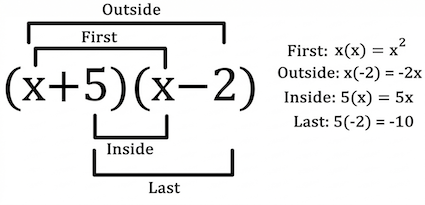
F:
O/I:
L:
The result matches the original problem.
💡 Tip
The 5-Second FOIL. You don’t always have to write it down. At the very least, mentally multiply the “Last” terms to check and the “Outer/Inner” terms to check . It takes 5 seconds and saves your grade.
Conclusion: From Mistakes to Mastery
Factoring is more about discipline than raw talent. By checking for the GCF first, being careful with your signs, and always verifying with FOIL, you eliminate 90% of the reasons students lose points.
Ready to put these tips into action? The best way to stop making these mistakes is through repetition. Pick a topic from our curriculum and start a practice session to build your “factoring muscle.”